Natural Flirty Replies for Every Stage of a Dating Chat

A natural flirty reply responds to something the other person actually said, adds a little warmth, and leaves them room to answer. You do not need a dramatic compliment or a clever comeback to every message. A small, specific reaction often gives you more to work with.
The useful question is: how much warmth does this conversation already have? A reply that feels playful after several mutual jokes can feel out of place after a single “hey.” Start with their message and choose a line you would be comfortable saying aloud.
For this guide, I chose everyday topics so the examples are easy to adapt without performing a different personality.
Below are eight invented exchanges for different stages of a dating-app conversation. These are editing examples, not real chat logs or proof of better response rates. Change details to match your actual conversation; do not pretend to share an interest or experience you do not have.
What makes flirty replies feel natural?
Use three parts: notice one detail, add one light reaction, and offer one easy next step. That last step might be a question, a small joke they can return, or an invitation when you both seem interested. You can leave out the question when the message already gives them an obvious response.
For example, “You had me at dumplings. What’s your favorite spot?” acknowledges an interest, signals warmth, and asks something specific. “You’re perfect” gives the other person far less to answer, especially early in a chat.
- Keep the message close to the length and energy of the exchange.
- Choose one tone: curious, playful, or lightly direct.
- Remove claims about chemistry that you cannot know yet.
- Send one message, then let them decide whether to continue.
If you have a screenshot you can share, the AI dating reply generator can draft options from the visible conversation. Edit the wording before sending it. If you prefer to work without an upload, the examples below stand on their own.
How do you flirt with a new match?
Their message: “I spent Sunday finding the best croissant in town.”
Too much for this stage: “We’re clearly soulmates. When are we getting married?”
A lighter reply: “A serious research project. Which bakery made the shortlist?”
A slightly warmer version: “A pastry expert and good company? I’m listening. Which place won?”
The warmer version adds a compliment without inventing a connection. Use it if their earlier messages have been friendly and engaged. If this is the first exchange, the lighter question is enough. You can flirt gradually instead of making the opening line carry the whole conversation.
How do you reply to a compliment?
Their message: “You have a really nice smile.”
An awkward pivot: “Thanks. What do you do for work?”
A natural reply: “Thank you—that made me smile again. Yours looks pretty good too.”
If there is a real profile detail to connect: “Thank you. Your hiking photo caught my eye too—where was that?”
Accepting a compliment does not require matching it with a bigger one. A brief thank-you can carry warmth by itself. If you return a compliment, choose something you actually noticed. Avoid a canned remark about their body when the conversation has stayed casual.
What can you say when they tease you?
Their message: “Pineapple on pizza? I’m questioning your judgment.”
A reply that escalates too fast: “You’ll forgive me when you fall in love with me.”
A playful reply: “Fair. I’ll make my case over pizza, but you get to choose the place.”
An earlier-stage version: “I accept the criticism. What’s your supposedly flawless order?”
The invitation works when a date already feels like a plausible next step. The question version lets you keep the joke going without pushing for plans. Keep teasing about a shared topic rather than a personal insecurity. If they sound uncomfortable, drop the joke.
How do you build on a shared joke?
Their message: “I still think I’d beat you at mini golf.”
A low-pressure reply: “Confident. I like it. Loser buys coffee?”
If you are not ready to meet: “I admire the confidence. Do you have an actual score to back this up?”
An ongoing joke gives the reply a reason to exist. You are continuing something you both contributed to. You do not need to manufacture a new flirt every time. When the joking feels one-sided, return to a straightforward question or let the conversation pause.
What if they say you would like a place?
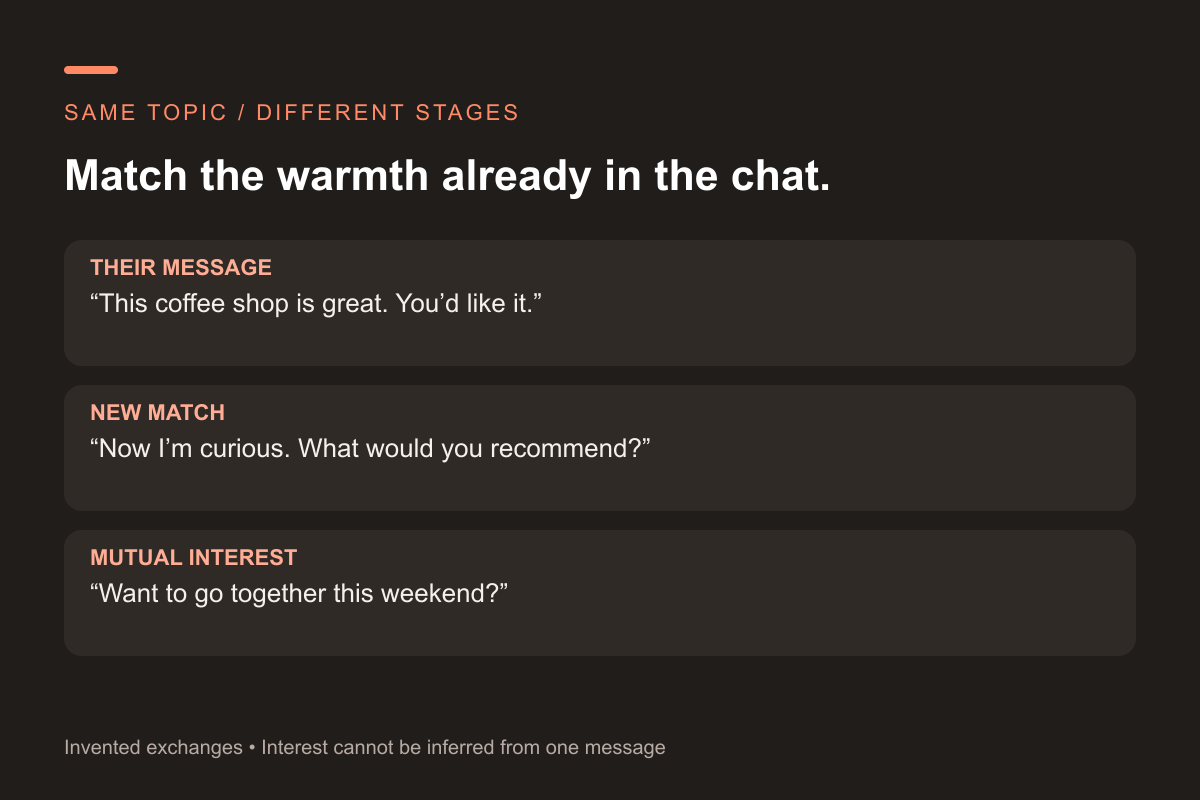
Their message: “This coffee shop is great. You’d like it.”
A warm reply: “Now I’m curious. What’s the order you’d recommend for me?”
If you have both discussed meeting: “That sounds like a good next coffee spot. Want to go together this weekend?”
The second version makes your interest clear while leaving them a choice. Keep the plan realistic. Avoid proposing a private setting before you have built trust; Tinder’s safety guidance recommends meeting in a public place and keeping control of your transport.
How do you turn flirting into a date?
Their message: “I’ve been wanting to try that new ramen place too.”
A vague reply: “We should do something sometime.”
A clearer reply: “Want to try it together? I’m free Thursday or Sunday.”
You do not have to hide a date invitation inside a joke. Offer a simple plan with an easy way to respond. If your schedules differ, ask what works for them. If they decline, accept it without trying to negotiate their interest.
For more examples that connect one message to the next, see our dating-app conversation examples. On Hinge, a like or comment can lead to a match; Hinge explains that flow in its help center. Start from the prompt or message in front of you; our Hinge reply guide covers that workflow.
What if their replies get shorter?
Their message: “Haha maybe.”
A pressuring reply: “Come on, don’t make me chase you.”
A calmer reply: “No pressure. We can leave it there for now.”
A short response can mean many things, including a busy moment or limited interest. You cannot diagnose it from one line. Do not use a flirty message to demand reassurance. If they want to continue, give them room to do so; repeated follow-ups make that choice harder.
How do you respond to a boundary?
Their message: “I’d rather keep it friendly.”
A respectful reply: “Thanks for telling me. I’ll keep it friendly.”
This is a moment for clarity. Leave out a comeback, a guilt trip, or another attempt to flirt. A boundary is information you should follow. If friendship is not what you want, you can end the exchange kindly rather than pretending to agree and continuing to push.
How do you edit flirty replies into your own voice?
Read the line aloud before sending it. Replace words you would never use, remove a pet name that has not become natural between you, and check that the message answers the actual topic. Keep one clear point rather than combining a compliment, a joke, a challenge, and an invitation.
A useful edit can be small. “Your culinary expertise has captivated me” becomes “Okay, I trust your food picks.” The shorter version gives you a voice you can keep using in the next message. If you would struggle to continue the style in person, choose a simpler line.
If you use DatingHelpAI, upload only a screenshot you are allowed to share and crop unnecessary identifying details. Choose a tone that fits the conversation, then review the draft yourself. Respect any capture restrictions in the app. Tinder documents profile screenshot protection in selected regions. Screenshots cannot reveal someone’s intentions or replace their words. The AI reply editing guide shows how to compare tones on the same message.
FAQ
What is a good flirty reply to “hey”?
Start lightly: “Hey—how’s your day going?” Add a specific profile detail if you genuinely noticed one. A single-word greeting gives little context, so a dramatic compliment or sexual joke can be a bigger leap than the exchange supports.
How do I respond to a flirty compliment?
Acknowledge it first. “Thank you—that made me smile” is enough. You can return a specific compliment if it feels honest, but you do not owe a more intense message or an immediate date invitation.
Can flirty replies restart a quiet conversation?
It can offer a new opening, but it cannot make someone interested. One relevant question is usually easier to answer than a complaint about their silence. If they do not respond, stop following up.
Can AI help me write flirty replies?
AI can suggest wording from context, but you still need to decide whether flirting fits the exchange. Treat suggestions as drafts, remove invented details, and choose words you would actually send. It cannot confirm attraction or guarantee a reply.
What To Do Next
If this guide helped you diagnose the problem, the next step is to test the right tool on a real conversation, opener, or profile screenshot.
Related Reading
View all articlesDating
AI Pickup Lines from Profile Photos: Examples and Tips
Turn a dating profile photo into a natural AI pickup line. Compare example openers, edit out assumptions, and learn when to use photo uploads or write manually.
Dating
Best AI Model for Dating Chat in 2026? DatingHelpAI Tested Six
Six AI models for dating chat compared: 576 text outputs, quality scores, first-attempt reliability, latency, image limits, and published prices.
Dating
Tinder vs Hinge vs Bumble Messaging Rules for 2026
Compare Tinder, Hinge, and Bumble messaging rules for 2026, including who can message first, how matches begin, and how Opening Moves and comments work.
About this content
Dating Help AI, operated by EasyGlobe, publishes product pages and dating-app workflow content to explain how the public tools work, document the current public product model, and help users apply suggestions with more context and care. For the current product overview and how uploads and comparison pages are handled, review the trust pages below.
The tools provide suggestions, frameworks, and second-pass review. They do not guarantee matches, replies, dates, or relationship outcomes. The content and outputs are educational dating-app guidance, not therapy, legal advice, or professional mental-health support.
Editorial review owner: Luhao Zhao, Founder and Product Lead, Dating Help AI, based in Los Angeles, California, United States. Product and trust-sensitive content is reviewed on a weekly cadence.