Tinder Profile Analyzer Guide for Better Matches
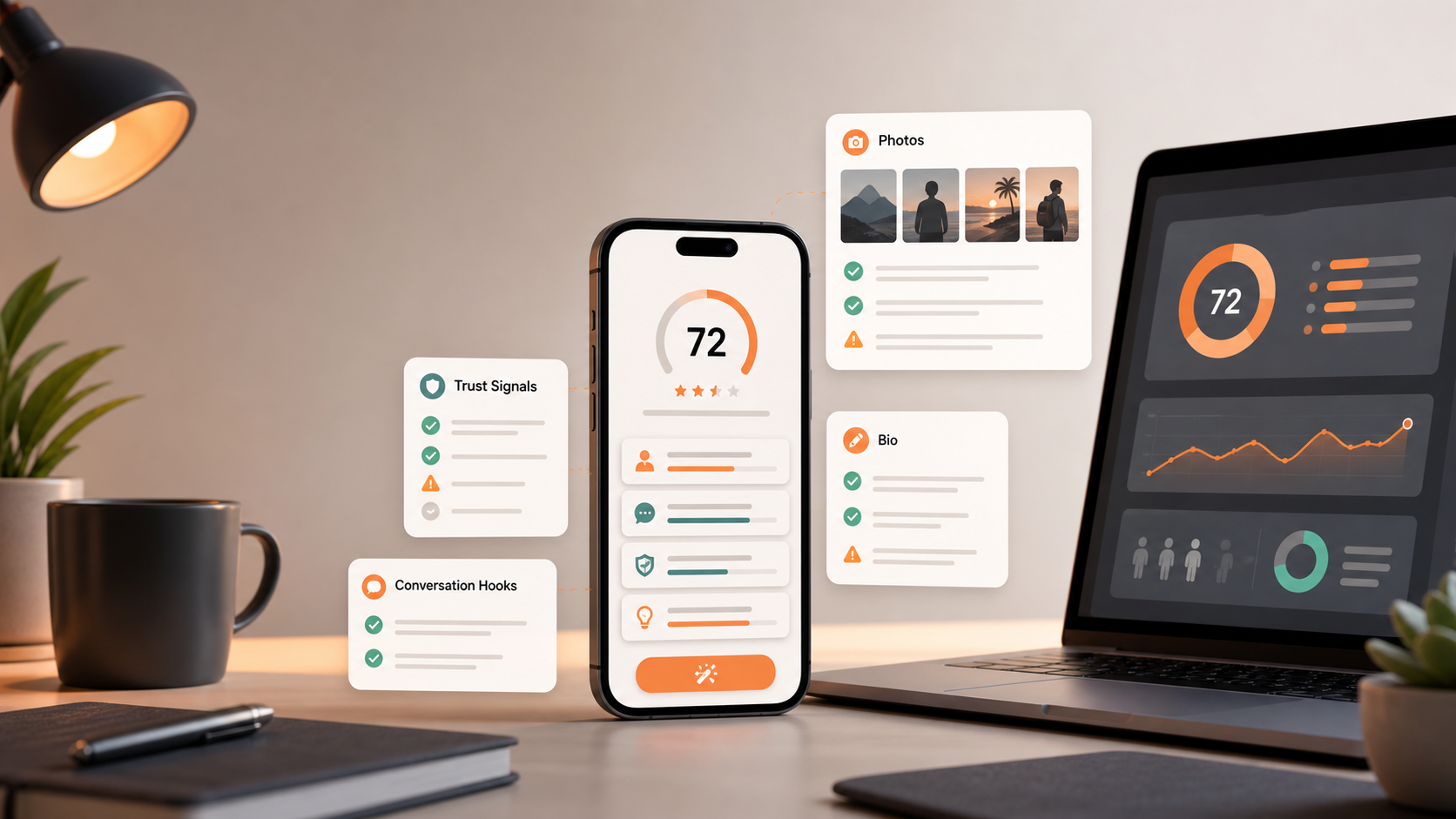
Pew Research Center found that 42% of U.S. adults ages 18 to 29 have used Tinder, making it the most-used dating app among the platforms Pew asked about in its 2022 survey. That means your profile is not competing in a small room. It is competing in a fast-moving feed where photos, bios, and tiny trust signals shape first impressions.
A Tinder profile analyzer helps you slow that feed down. Instead of guessing whether your first photo works, whether your bio gives people something to answer, or whether your profile feels consistent, you can review the profile as a system.
This guide explains what a Tinder profile analyzer should check, how to prepare your screenshots, how to read the feedback, and what to change first.
Key Takeaways
- Pew found that 42% of U.S. adults ages 18 to 29 have used Tinder.
- Tinder says profiles can include photos, bios, lifestyle tags, interests, pronouns, goals, languages, job, school, city, gender, and orientation.
- A strong review should separate photo issues, bio issues, trust signals, and opener hooks.
- Use analyzer feedback as a decision aid, not a promise of matches, replies, or dates.
For a hands-on review, use the AI profile analyzer. If you want a broader checklist first, start with the dating profile optimizer.
What Is a Tinder Profile Analyzer?
A Tinder profile analyzer is a diagnostic tool for your dating profile. Pew reports that 45% of Americans who are single and looking used a dating site or app in the past year, so the practical goal is simple: make your profile easier to understand, trust, and respond to before someone swipes away.
The analyzer should look at the same signals a real viewer notices quickly:
- Whether your first photo clearly shows you
- Whether your photo set gives enough variety
- Whether your bio has a specific conversation hook
- Whether profile fields create clarity or friction
- Whether the overall impression matches the type of connection you want
This matters because Tinder profiles are not judged one element at a time. A great photo can be weakened by a vague bio. A good bio can be ignored if the first photo is dark, confusing, or crowded. A profile analyzer is useful because it treats the profile as a complete first impression.
The best feedback is specific. "Be more interesting" is not useful. "Move the clear smiling headshot to photo one, replace the blurry group shot, and add one bio line about your weekend cooking project" is useful because you can act on it today.
Why Does Your Tinder Profile Need a Review?
In its July 2024 Photo Selector announcement, Tinder reported that 85% of surveyed singles said dating app profiles are important for representing their true selves, while 52% said choosing a profile image is hard. That explains the real problem: most people know their profile matters, but they do not know which detail is hurting them.
Profile review helps because dating profiles create several kinds of uncertainty:
- Visual uncertainty: Can someone tell which person you are?
- Intent uncertainty: Are you looking for something casual, serious, social, or unclear?
- Personality uncertainty: Does your profile show a real person or a generic template?
- Safety uncertainty: Does the profile feel current, honest, and low-risk to engage with?
Tinder has also moved deeper into AI-assisted profile experiences. Its Help Center says Photo Selector uses AI to identify photos that might work as profile photos. Tinder also describes Photo Insights and AI-powered matching as optional features that use profile information, answers, and, when users opt in, camera roll photo insights.
That does not mean you should outsource your identity to a tool. It means profile quality is now important enough that major dating platforms are building product features around it. A profile analyzer gives you a similar second-pass review before you update your public profile.
What Should a Tinder Profile Analyzer Check First?
Tinder's own FAQ says the best pictures are in focus, show you clearly, avoid sunglasses, and do not make friends the main subject. Start there. Your first photo carries the most scanning weight because it answers the basic question: "Who am I looking at?"
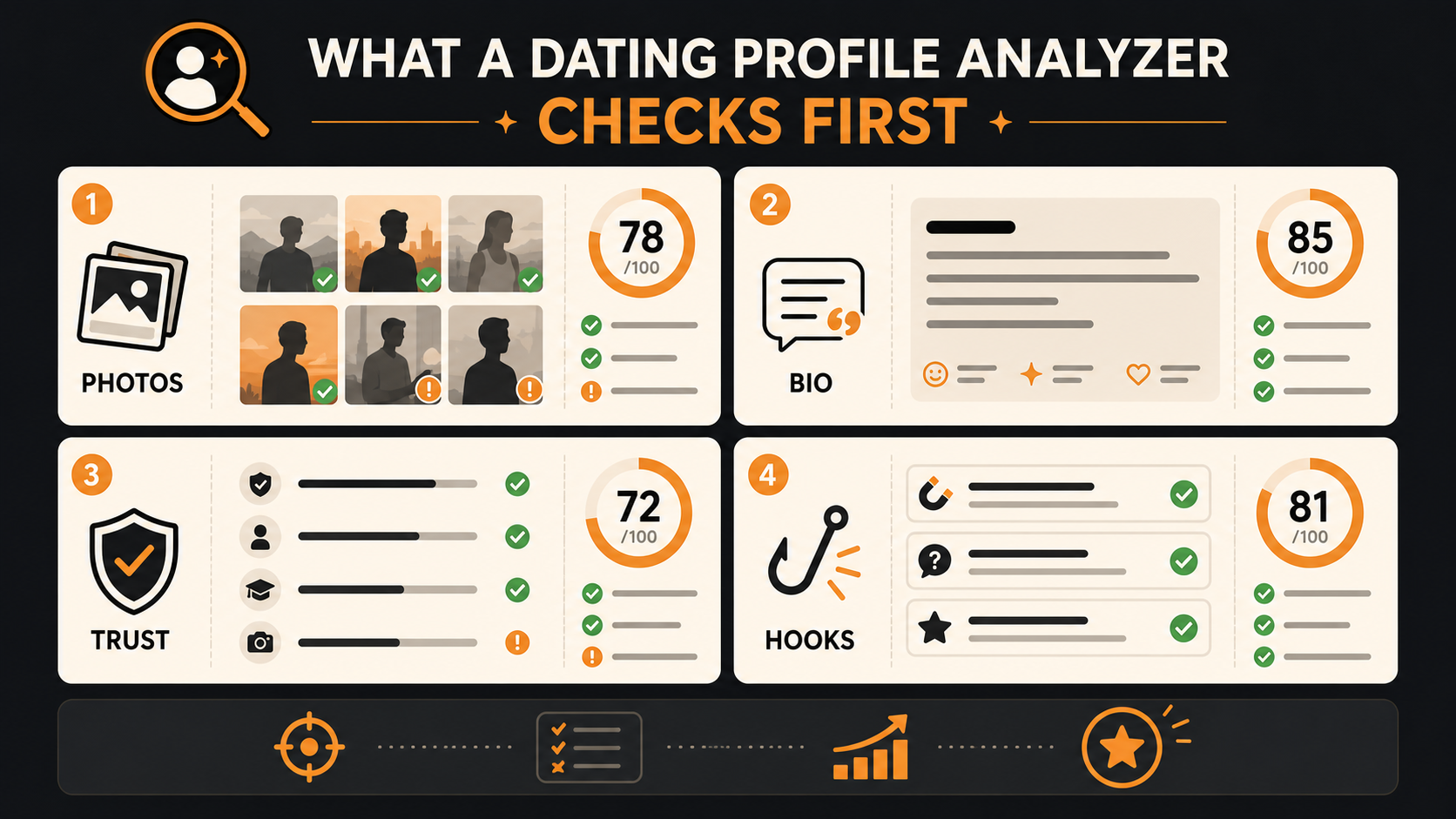
A good analyzer should flag these photo issues first:
- First photo does not show your face clearly
- Main image includes sunglasses, heavy shadow, or a distant crop
- Too many group photos make your identity unclear
- Photos repeat the same angle, outfit, or setting
- No image shows your full body or everyday style
- Photos look old, over-edited, or inconsistent with each other
Tinder's Photo Selector documentation says the feature considers qualities like lighting and composition, and it filters out group photos. That is a useful mental model even if you are reviewing manually: prioritize clarity before cleverness.
Your photo set should answer three questions quickly:
- What do you look like?
- What is your life like?
- What would be easy to ask you about?
That third question is often missed. A hiking photo, cooking photo, dog photo, concert photo, or travel photo does more than show lifestyle. It gives a match an easy opener. If every photo is only a mirror selfie, the other person has very little to work with.
How Should It Review Your Bio and Profile Fields?
Tinder's Help Center lists editable profile areas such as photos, About Me/Bio, lifestyle details, interests, pronouns, height, relationship goals, languages, job, school, and city. A profile analyzer should review these fields for clarity, because a weak bio often creates more confusion than attraction.
The bio does not need to be long. It needs to be specific.
Weak bios usually sound like this:
- "Just ask"
- "Here for a good time"
- "Love travel, food, and music"
- "Not on here much"
- "I never know what to write here"
These lines are common because they feel low-risk. The problem is that they do not create a real path into conversation.
Stronger bios usually do one of three jobs:
- Show a concrete interest: "Currently trying to make better ramen at home."
- Invite a small opinion: "Settle this: best first-date food, tacos or sushi?"
- Frame your dating intent lightly: "Looking for someone who likes weeknight walks and weekend plans."
Your analyzer should also check whether profile fields support the same story. If your bio says you love quiet bookstores but every photo is a nightclub shot, the profile may feel inconsistent. If your relationship goal is serious but your bio only uses jokes, the profile may not help the right people self-select.
How Do You Use a Tinder Profile Analyzer Step by Step?
Pew found that one-in-ten partnered U.S. adults met their current spouse or partner through a dating site or app, and the share rises to one-in-five among partnered adults ages 18 to 29. A structured review is worth doing because a profile can influence serious outcomes, not just casual swipes.
Here is a practical workflow.
Step 1: Capture the Profile as Other People See It
Take screenshots of the full profile flow, not just your favorite photo. Include the first photo, remaining photos, bio, interests, lifestyle tags, relationship goal, job, school, location, and prompts if visible.
The goal is to review the public impression. Do not crop away awkward parts just because you already know what they mean.
Step 2: Run the Profile Through the Analyzer
Upload the screenshots to the profile analyzer and ask for feedback on photos, bio clarity, profile consistency, and opener hooks. The best prompt is direct: "Review this Tinder profile for first-photo quality, trust signals, conversation hooks, and changes I should make first."
This keeps the output focused on the parts that affect first impressions.
Step 3: Sort Feedback by Impact
Do not change everything at once. Sort the feedback into three levels:
- Fix now: blurry first photo, confusing group photo, empty bio, outdated image
- Improve next: better bio hook, more specific interest, stronger full-body photo
- Test later: photo order, small wording changes, alternate joke or question
The first group matters most because it removes friction. The second group adds personality. The third group is for iteration after the obvious issues are fixed.
Step 4: Rewrite the Bio Around One Hook
Pick one specific thing you would enjoy talking about. Then write one or two lines around it.
Examples:
- "Currently learning to make handmade pasta. Results are improving, cleanup is not."
- "Weekend plan: coffee, a long walk, and pretending I know how to pick good wine."
- "Tell me your most defensible unpopular food opinion."
The point is not to sound perfect. The point is to make replying easy.
Step 5: Recheck the Profile After Changes
After you update photos and bio text, run the revised profile through the analyzer again. Look for fewer clarity problems and more natural conversation hooks.
If the analyzer still flags the same issue, listen to the pattern. One note can be subjective. The same note twice usually points to a real profile problem.
What Should You Change After the Analyzer Gives Feedback?
Tinder's 2024 Photo Selector announcement said most single women prefer men's profiles with at least four images that genuinely reflect personality, based on Tinder-cited data. Treat that as platform-specific guidance: your first update should usually improve photo variety and authenticity before tiny wording tweaks.
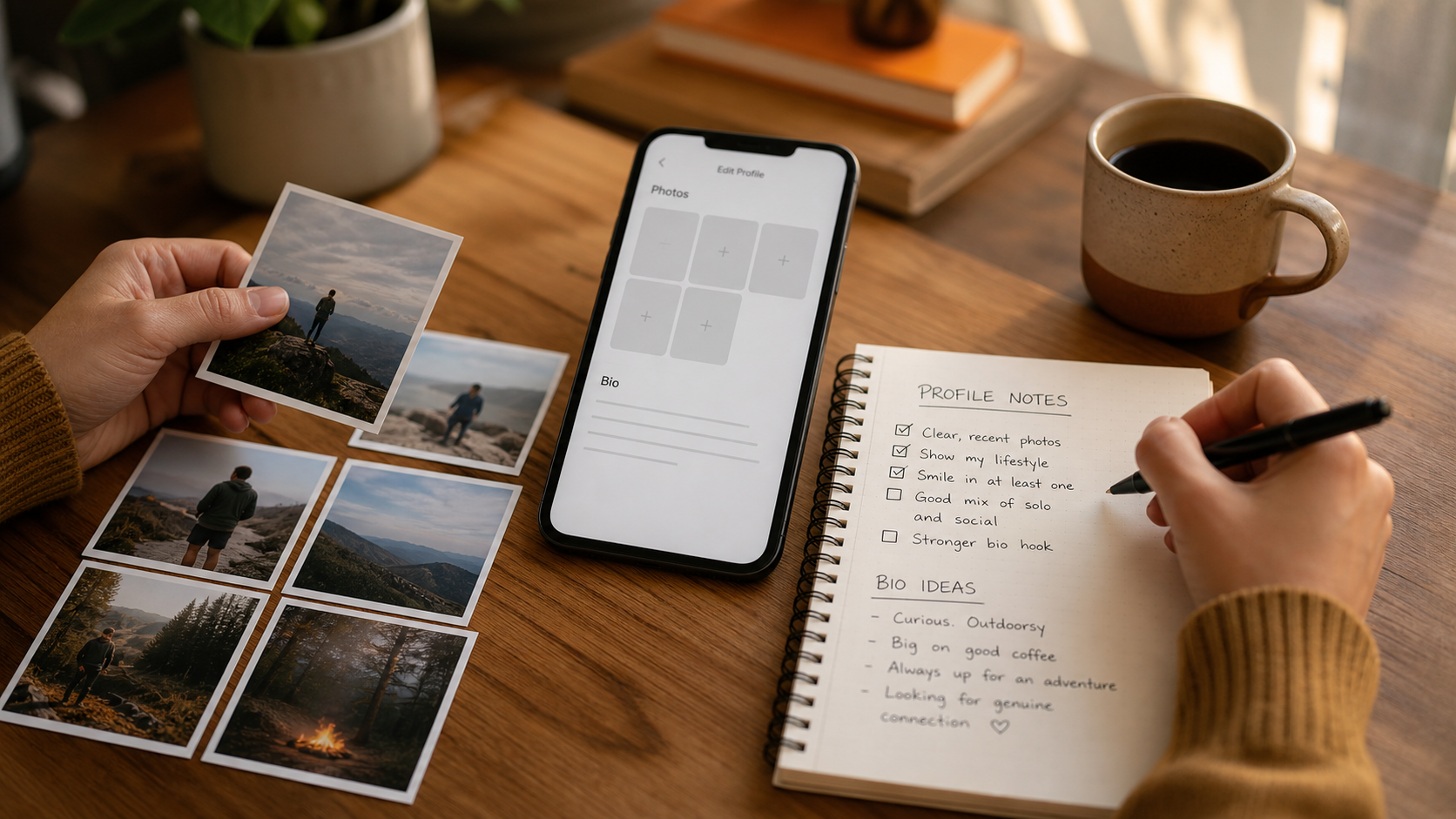
Use this order.
1. Fix the First Photo
Use a clear, recent, solo photo with your face visible. Good lighting matters more than an expensive camera. If your current lead photo is a group shot, distant travel picture, or sunglasses selfie, replace it.
2. Add One Context Photo
Context photos show what your life feels like. That could be cooking, hiking, reading outside, playing music, visiting a museum, walking your dog, or doing something social.
Avoid turning the profile into a resume. You are giving someone an easy detail to ask about.
3. Remove Confusing or Repetitive Images
If three photos show the same face angle in the same room, keep the best one. If a photo makes people ask "which one are you?" it should not be early in the set.
One good group photo can show social proof. Several group photos create friction.
4. Make the Bio More Answerable
A good Tinder bio is not an autobiography. It is a small invitation.
Try this formula:
- One concrete interest
- One light detail
- One easy question or implication
For example: "Trying every dumpling spot in the city. Current ranking system is deeply unfair but emotionally honest."
5. Align the Profile With Your Intent
If you want a relationship, make the profile feel stable enough for someone relationship-minded to engage. If you want casual dating, be clear without sounding careless. If you are unsure, write for curiosity and respect rather than ambiguity.
What Mistakes Should You Avoid?
Tinder says Photo Selector is a decision aid and that users remain responsible for the photos they upload. Apply the same rule to any Tinder profile analyzer. Use feedback to make better choices, but do not let a tool erase your judgment, identity, or boundaries.
Avoid these common mistakes.
Mistake 1: Optimizing for everyone
A profile that tries to attract everyone usually feels vague. Your goal is not universal approval. Your goal is to be clear enough for compatible people to recognize something they like.
Mistake 2: Using AI to sound unlike yourself
AI can help clarify a bio, but it should not invent a personality. If a line sounds too polished for how you actually text, rewrite it until it sounds like you.
Mistake 3: Over-focusing on jokes
Humor helps, but a profile made only of jokes can feel evasive. Pair humor with a real detail.
Mistake 4: Keeping outdated photos
Old photos create trust problems. Tinder's photo tips recommend keeping profile pictures current, and that advice is practical. If you would feel nervous showing up looking different from your profile, update the photo.
Mistake 5: Ignoring privacy
Before uploading screenshots anywhere, remove details you do not need for feedback. Do not include private chats, phone numbers, addresses, workplace-sensitive details, or other people's personal information.
What Does a Strong Tinder Profile Look Like After Review?
In its July 2024 Photo Selector announcement, Tinder said it serves about 50 million monthly users across 190 countries and 45+ languages. In a network that large, a strong profile is not the flashiest profile. It is the profile that makes recognition, trust, and response feel easy.
After review, your profile should have:
- A clear first photo where your face is visible
- A varied photo set that shows personality and context
- No early group photo confusion
- A bio with one specific hook
- Profile fields that support your actual dating intent
- A tone that matches how you would message in real life
- Enough detail for someone to send a personalized opener
The final test is simple: could a match write you a specific first message without working too hard?
If yes, your profile is doing its job. If no, add one clearer photo, one more concrete bio detail, or one stronger interest signal.
FAQ
Is a Tinder profile analyzer worth using?
Yes, a Tinder profile analyzer is worth using if you want specific feedback instead of generic profile tips. Pew found that 42% of U.S. adults ages 18 to 29 have used Tinder, so small first-impression improvements can matter in a crowded app environment.
Can a profile analyzer guarantee more matches?
No. A profile analyzer can identify likely friction points, but it cannot guarantee matches, replies, dates, or relationships. Your location, age range, preferences, activity, timing, and local dating pool also affect outcomes.
What screenshots should I upload for a profile review?
Upload screenshots that show your profile the way another Tinder user would see it. Include photos, bio, interests, lifestyle tags, relationship goals, and any other visible fields. Remove private or unnecessary personal information before uploading.
Should I use AI-generated Tinder photos?
Be careful. AI can help select or review photos, but heavily generated images may create trust problems if they do not match how you look in real life. Use clear, current photos that genuinely represent you.
What should I do after improving my profile?
After improving your profile, work on the first message. Use details from the other person's profile, ask an easy question, and keep the opener natural. The dating app opener generator can help turn profile details into message ideas.
Sources
- Pew Research Center, The who, where and why of online dating in the U.S.
- Tinder Help Center, Editing your profile
- Tinder Help Center, Photo Selector
- Tinder Help Center, Photo Insights
- Tinder Help Center, AI-powered matching
- Tinder Newsroom, Tinder unveils Photo Selector AI
What To Do Next
If this guide helped you diagnose the problem, the next step is to test the right tool on a real conversation, opener, or profile screenshot.
Related Reading
View all articlesDating
Natural Flirty Replies for Every Stage of a Dating Chat
Find flirty replies for new matches, compliments, playful teasing, and asking for a date. Adapt each example to your chat without adding pressure.
Dating
AI Pickup Lines from Profile Photos: Examples and Tips
Turn a dating profile photo into a natural AI pickup line. Compare example openers, edit out assumptions, and learn when to use photo uploads or write manually.
Dating
Best AI Model for Dating Chat in 2026? DatingHelpAI Tested Six
Six AI models for dating chat compared: 576 text outputs, quality scores, first-attempt reliability, latency, image limits, and published prices.
About this content
Dating Help AI, operated by EasyGlobe, publishes product pages and dating-app workflow content to explain how the public tools work, document the current public product model, and help users apply suggestions with more context and care. For the current product overview and how uploads and comparison pages are handled, review the trust pages below.
The tools provide suggestions, frameworks, and second-pass review. They do not guarantee matches, replies, dates, or relationship outcomes. The content and outputs are educational dating-app guidance, not therapy, legal advice, or professional mental-health support.
Editorial review owner: Luhao Zhao, Founder and Product Lead, Dating Help AI, based in Los Angeles, California, United States. Product and trust-sensitive content is reviewed on a weekly cadence.