How to Get More Matches on Dating Apps in 2026

To get more matches on dating apps, improve the whole path from discovery to conversation. Start with a clear first photo, add specific profile details that make replying easy, check whether your filters are too narrow, and use the app consistently enough to learn what is working. After a match, send a first message tied to something in the profile instead of a generic greeting.
There is no universal hack that guarantees matches. Location, age range, app supply, preferences, and timing all change the result. Treat the steps below as a controlled profile-improvement process, not a promise that one photo or one algorithm trick will transform every account.
Fast checklist: how to get more matches on dating apps
Use this order before paying for extra exposure or rebuilding your whole profile:
- Lead with one current, well-lit photo where your face is easy to see.
- Add three to five different photos that show more than one side of your life.
- Replace generic bio claims with two or three specific details someone can ask about.
- Answer prompts with an opinion, story, or invitation to respond.
- Check distance, age, location, and dealbreaker settings for accidental over-filtering.
- Use the app consistently, but swipe deliberately instead of trying to game an undocumented score.
- Track profile changes for at least seven days before deciding whether they helped.
- If you match but conversations stall, improve the opener and reply stage instead of changing the profile again.
Use the free dating profile analyzer when you want a structured second opinion on photos, bio clarity, and prompt quality.
Diagnose where your dating-app funnel is breaking
“Not getting matches” can describe several different problems. Fixing the wrong stage creates more noise without solving the bottleneck.
You receive almost no likes or matches
Start with profile visibility and clarity:
- Make sure your discovery settings are not narrower than you intended.
- Check that your first photo clearly shows you.
- Remove duplicate photos and photos that need a long explanation.
- Make your relationship goals and key preferences accurate.
- Add profile details that help the app and potential matches understand you.
This does not prove that an account is hidden or “shadowbanned.” A small local pool, narrow filters, incomplete verification, low recent activity, or a profile that is hard to read can produce the same symptom.
You get matches but few first messages
Your profile may create initial interest without giving the other person an easy conversation hook. Add something specific: a food opinion, a weekend ritual, a place you want to visit, or a prompt answer with a clear point of view.
You get conversations but they fade quickly
That is mainly a messaging problem. Use a profile-based dating app opener for the first message, then use the AI dating reply generator after the other person responds.
Improve your first dating profile photo
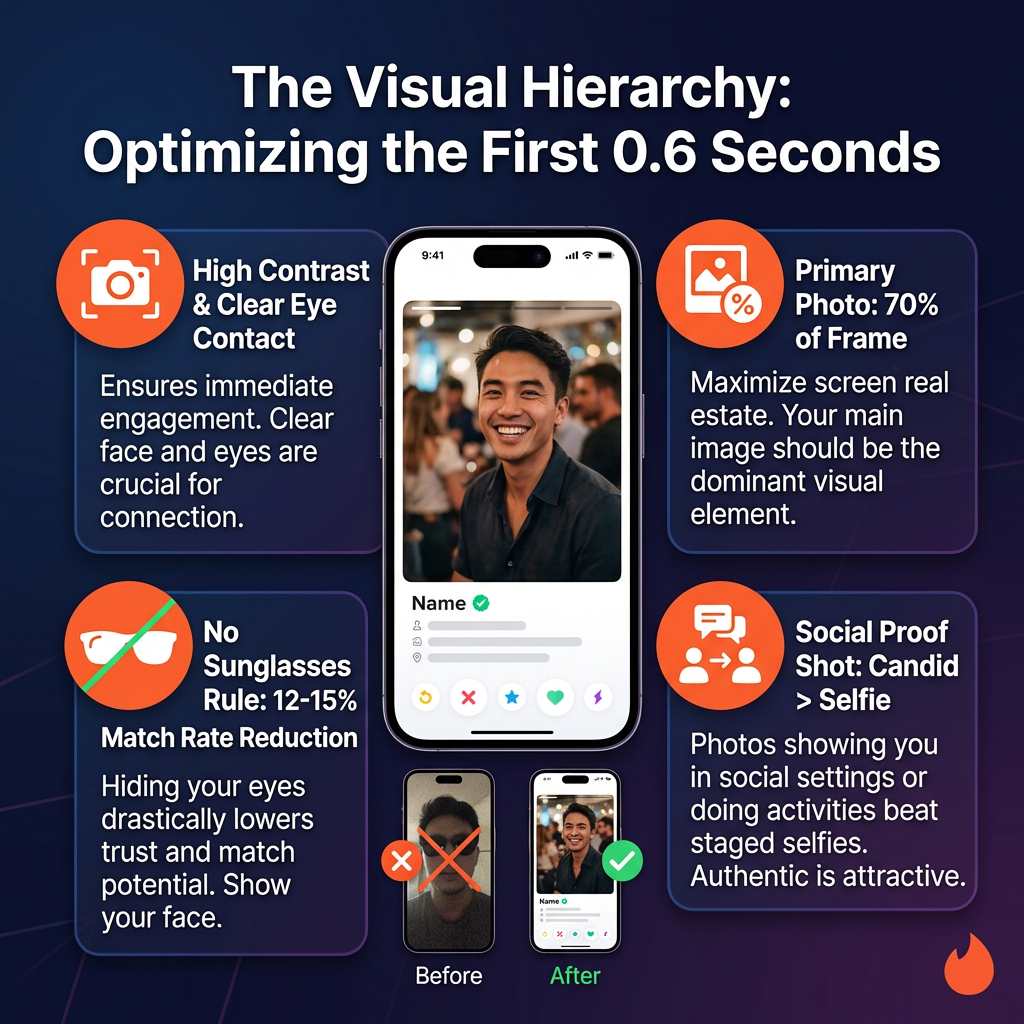
People make fast judgments in swipe-based interfaces, but there is no reliable universal “0.6-second rule” for every dating app. The practical goal is simpler: make the first photo easy to understand at a glance.
- Use a current photo with clear lighting and a visible face.
- Avoid making the first image a group photo.
- Do not lead with a distant activity shot where you are difficult to identify.
- Use sunglasses, costumes, and novelty photos later in the profile when they add context.
- Choose an expression and setting that match how you would want to appear on a first date.
Tinder’s Photo Insights documentation describes clear, diverse photos that show different sides of a person. It does not publish a guaranteed match-rate lift for removing sunglasses or using a particular photo formula.
Build a photo set that answers four questions
A useful photo set helps a stranger understand four things without reading a long caption:
- What do you look like clearly?
- What does your everyday style feel like?
- What do you genuinely enjoy doing?
- What would spending time with you look like?
A practical sequence is:
- Photo 1 — clear identity: an easy-to-recognize solo photo.
- Photo 2 — full context: a full-body or wider lifestyle photo.
- Photo 3 — real interest: an activity you actually do.
- Photo 4 — social context: a natural social photo where you remain identifiable.
- Photo 5 — personality: something playful, creative, or conversation-worthy.
This is a review framework, not an official platform formula. Keep only the photos that are current and accurate.
Write a bio that gives matches something to say
Generic statements are difficult to reply to:
- “I love travel.”
- “Foodie.”
- “Just ask.”
- “Fluent in sarcasm.”
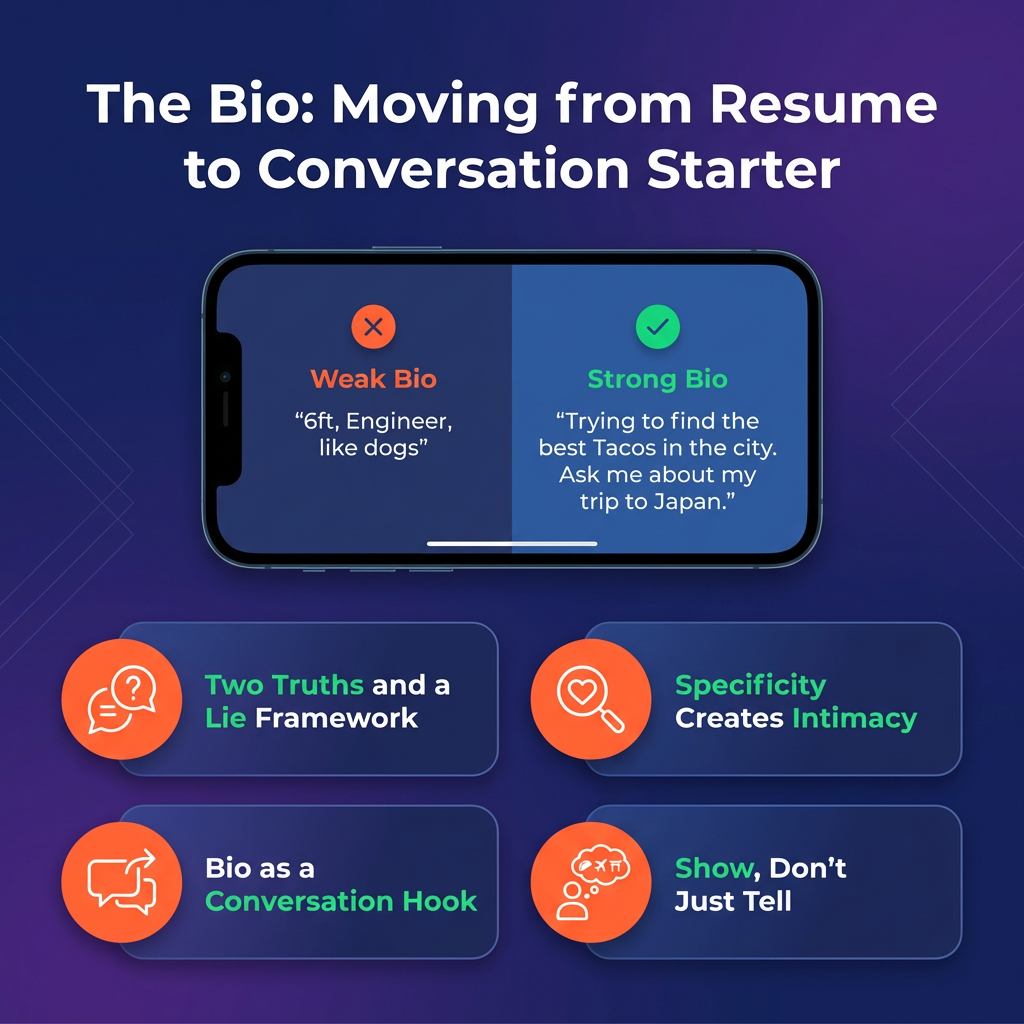
Specific details create usable conversation hooks:
- “Currently ranking every dumpling spot within a 20-minute walk.”
- “My ideal Sunday is a long coffee, a used bookstore, and cooking something unnecessarily complicated.”
- “Ask me why I will defend window seats on every flight.”
Use two or three details that are true, easy to understand, and different from one another. You do not need to turn the bio into a résumé.
Tinder, Bumble, and Hinge require different profile choices
The apps do not disclose complete ranking formulas, and their products change. The safest strategy is to use what each platform publicly confirms and avoid pretending that undocumented community theories are facts.
Tinder: prioritize clarity, interests, and consistent use
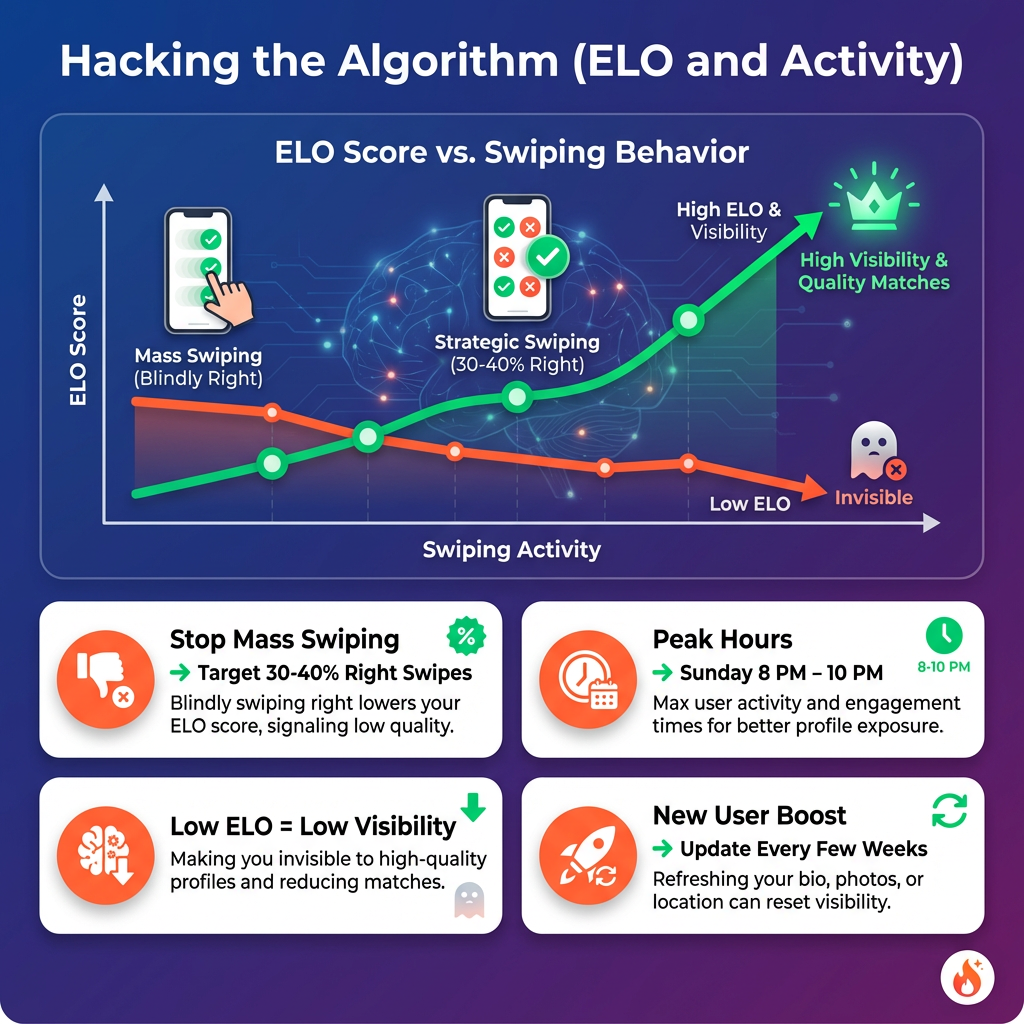
Tinder’s matching explanation says it considers activity, distance, interests and lifestyle information, photo patterns, and Likes and Nopes. Tinder also explicitly says it no longer relies on Elo.
What to do:
- Complete the profile with accurate interests and lifestyle details.
- Use photos that show distinct, recognizable parts of your life.
- Keep discovery settings realistic for your location.
- Use the app regularly enough to interact with active people.
- Swipe based on genuine interest, not a fixed ratio invented to manipulate an “Elo score.”
Bumble: make the first move easier
Bumble profiles benefit from details that naturally support an Opening Move or first message. Give a match a simple route into the conversation with an opinion, prompt, or specific activity.
Bumble’s published activity data shows that peak periods vary by day rather than following one universal Sunday-night rule. For example, the page lists Monday from 7–8 p.m. and Sunday from 3–4 p.m. These are Bumble’s platform-level observations, not a guarantee for every city or user.
What to do:
- Use prompts that can be answered without research or a long story.
- Add one detail that makes an Opening Move feel personal.
- Test activity near Bumble’s published peak periods in your own location.
- Review the result over multiple days instead of judging one session.
Hinge: use prompts and preferences as real signals
Hinge’s profiling explanation says its recommendations can use information such as age, gender, location, preferences, and who people like, skip, or match with. Its Most Compatible documentation also mentions mutual Dealbreakers, recent activity, and shared liking patterns.
What to do:
- Make prompts specific enough to invite a comment.
- Use Dealbreakers only for genuine non-negotiables.
- Comment on a photo or prompt when sending a Like.
- Keep the profile aligned with the kind of person and relationship you actually want.
Stop trying to game a secret dating-app score
An earlier version of this guide described “low ELO” as the reason a profile might stop receiving matches. Tinder’s current documentation directly says Elo is no longer used.
Likes, skips, profile information, preferences, activity, and local supply can all affect what people see, but the platforms do not publish exact weights. No official source confirms that one fixed right-swipe ratio, a tiny bio edit, or deleting and recreating an account will reliably reset distribution.
Deliberate use is still sensible. It helps you:
- Spend attention on people you would actually meet.
- Notice which profile types and conversations fit you.
- Avoid burnout from treating the app like a slot machine.
- Make cleaner observations when you change your profile.
Run a seven-day profile improvement test
Change a small number of variables, record what happened, and avoid claiming causation from one lucky day.
Day 1: record the baseline
Write down:
- Current photos and their order.
- Bio and prompt answers.
- Discovery radius and age range.
- Number of likes, matches, replies, and dates in the previous seven days.
- Whether you used any paid visibility feature.
Day 2: fix the first photo
Replace the first photo only if it is unclear, outdated, hidden behind sunglasses, or difficult to identify. Keep the rest of the profile stable.
Day 3: add two conversation hooks
Replace generic profile statements with two specific details. Do not rewrite every section at once.
Day 4: check platform settings
Review location, distance, age range, relationship goals, and Dealbreakers. Expand only the filters you are genuinely comfortable changing.
Day 5: use the app during an active period
Test one period when your chosen app is likely to have active users. For Bumble, you can compare your local result with its published day-by-day activity windows. Do not assume the same hour applies to Tinder or Hinge.
Day 6: improve the conversation stage
For new matches, send one message that references a visible profile detail and asks one easy question. Avoid sending the same line to everyone.
Day 7: review the whole funnel
Compare profile views or likes when the app exposes them, matches, first-message replies, and meaningful conversations. One account and one week cannot prove a universal rule, but the record can show which stage deserves the next test.
What to do after you get a match
A match is permission to start a conversation, not proof that a particular line will work.
Use this simple sequence:
- Reference one specific detail from the profile.
- Add a short reaction, opinion, or playful angle.
- Ask one question that is easy to answer.
- Build on their reply instead of switching topics immediately.
- Suggest a date or another contact method only when both people seem comfortable.
There is no evidence-based rule that every conversation should move to Snapchat after five or ten messages. The FTC’s romance-scam guidance notes that quickly moving a conversation off-platform can also appear in scam patterns. Prioritize mutual comfort, keep personal information private, and never send money to someone you have not met.
Should you pay for Boost or Spotlight?
Paid visibility can increase exposure, but exposure and matches are different outcomes.
- Tinder says Boost can provide up to 10 times more profile views while boosting. It does not promise 10 times more matches.
- Bumble says Spotlight shows a profile to more people for 30 minutes. Bumble does not publish one universal match multiplier on that help page.
Fix profile clarity before buying extra exposure. Otherwise, you may only show the same weak first impression to more people.
If you still get zero matches
Do not jump straight to “shadowban” or a supposedly low hidden score. Use a broader diagnosis:
- Confirm the account is active and the app is functioning normally.
- Check whether verification or moderation notices require action.
- Review location, distance, age range, and Dealbreakers.
- Compare your available match pool with the size of your location.
- Replace an unclear first photo.
- Add accurate profile details and complete empty sections.
- Ask a trusted person for feedback or use the dating profile analyzer.
- Contact the platform’s support team if you suspect a technical or account-status problem.
Deleting an account is not a proven algorithm reset. Platform data-retention rules are privacy and safety policies, not instructions for restoring reach.
Ghosting is common, but it is not a profile conversion rate
Pew Research Center reported that 53% of U.S. adults with online-dating experience said they had ever been ghosted. That does not mean 53% of matches or conversations end in ghosting.
Use the statistic as context, not a benchmark for your account. Track your own stages: matches, first replies, sustained conversations, and dates.
Frequently asked questions
How long should I test a new dating profile?
Give a meaningful change at least seven days when possible, and record location, filters, activity, paid features, and message behavior. Small samples are noisy, so avoid declaring a winner after one evening.
Do sunglasses reduce matches by a specific percentage?
No reliable platform source supports one universal percentage. A clear first photo is easier to recognize, so move sunglasses photos later unless they add important context.
Does Tinder still use an Elo score?
No. Tinder’s current matching documentation says Elo is outdated and that the service uses a dynamic system involving activity, profile information, Likes, and Nopes.
How can I get more matches on Bumble?
Use clear photos, add prompts that make the first move easy, verify your filters, and test activity across several days. Bumble publishes different peak periods for different days, so there is no single best hour for everyone.
How can I get more matches on Hinge?
Use accurate preferences and Dealbreakers, write specific prompt answers, and send comments tied to a photo or prompt. Hinge says recommendations can use profile information, preferences, recent activity, and patterns in Likes, skips, and matches.
Will Tinder Gold or Bumble Premium automatically get more matches?
No. Paid features can increase access or visibility, but they do not make a profile more relevant or guarantee matches. Improve the profile first, then measure whether paid exposure changes the result.
Should I move a match off the app quickly?
Only when both people are comfortable. Avoid a rigid message-count rule, protect personal information, and treat pressure to move platforms or send money as a safety warning.
Sources and methodology
This guide separates platform documentation, independent survey data, and practical recommendations. Platform documentation describes publicly confirmed product behavior; it does not reveal every ranking weight. Practical checklists are editorial guidance, not guaranteed performance claims. Sources were checked on July 28, 2026.
- Tinder: Powering Tinder — The Method Behind Our Matching — activity, distance, interests, photo patterns, Likes/Nopes, and the retirement of Elo.
- Tinder: Photo Insights — clear, diverse photos and photo-suggestion context.
- Tinder: Boost — up to 10 times more profile views during a Boost, not a match guarantee.
- Bumble: Best Times to Get On Bumble — day-specific activity periods published from Bumble data.
- Bumble: What is Spotlight? — 30-minute visibility feature without a universal match multiplier.
- Hinge: Automated Decision-Making and Profiling — profile, preference, and behavior signals used in recommendations.
- Hinge: What is Most Compatible? — Dealbreakers, recent activity, and shared liking patterns.
- Pew Research Center: Personal Experiences and Attitudes of Daters — the distinction between ever experiencing ghosting and a per-conversation rate.
- Federal Trade Commission: What To Know About Romance Scams — safety context for rapid off-platform moves and requests for money.
What To Do Next
If this guide helped you diagnose the problem, the next step is to test the right tool on a real conversation, opener, or profile screenshot.
Related Reading
View all articlesDating
AI Pickup Lines from Profile Photos: Examples and Tips
Turn a dating profile photo into a natural AI pickup line. Compare example openers, edit out assumptions, and learn when to use photo uploads or write manually.
Dating
Best AI Model for Dating Chat in 2026? DatingHelpAI Tested Six
Six AI models for dating chat compared: 576 text outputs, quality scores, first-attempt reliability, latency, image limits, and published prices.
Dating
Tinder vs Hinge vs Bumble Messaging Rules for 2026
Compare Tinder, Hinge, and Bumble messaging rules for 2026, including who can message first, how matches begin, and how Opening Moves and comments work.
About this content
Dating Help AI, operated by EasyGlobe, publishes product pages and dating-app workflow content to explain how the public tools work, document the current public product model, and help users apply suggestions with more context and care. For the current product overview and how uploads and comparison pages are handled, review the trust pages below.
The tools provide suggestions, frameworks, and second-pass review. They do not guarantee matches, replies, dates, or relationship outcomes. The content and outputs are educational dating-app guidance, not therapy, legal advice, or professional mental-health support.
Editorial review owner: Luhao Zhao, Founder and Product Lead, Dating Help AI, based in Los Angeles, California, United States. Product and trust-sensitive content is reviewed on a weekly cadence.